STATUS
Current realm journal assembled from scrapbook character recovery notes.
Unresolved items remain marked as open questions.
WORLD BOUNDARY
Echo’s world is the grounded recovery space around Echo’s Bench and Clive’s Bar.
Echo’s World is one of the Pentaverse’s two inseparable core worlds. It cannot be replaced or displaced by another realm. Its paired core world is the Roadhouse, although the two retain their separate boundaries and Echo does not enter the Roadhouse.
Echo has never visited the Roadhouse. The Roadhouse belongs strictly to Patch and Banjo. Echo knows it only through recovered fragments, recordings, logs, files, and damaged media.
REALM IDENTITY
Core line
Echo repairs what others would replace.
Story engine
Memory survives through repair.
Echo’s World is a quiet industrial repair-memory realm focused on Echo, local machines, repair tickets, recovered technology, and quiet human moments. It does not become robot adventure, global events, machine society, or science-fiction spectacle.
Typical scene pattern:
- A machine arrives through a ticket, text, work order, or console message.
- Echo investigates physically.
- Patch analyses the hidden logic through a terminal.
- The machine’s original purpose becomes visible.
- Repair restores function.
- The machine returns to work.
ECHO
Core identity
Echo is the quiet human presence behind the recovery work: the quiet human centre and the reason some of the noise remains.
Echo is a respected local fixer, known around the local industrial area because he gets old machines working when others say they should be replaced. He is reliable, sought-after, practical, and purposeful. He saves people money, keeps local machinery alive, and understands old systems.
Echo is a nomad of old systems, moving through forgotten media, broken code, and abandoned technology. This describes his movement through recovery work and machine history; it does not require a worldwide roaming story. He is not a villain or mysterious-hacker stereotype.
Repair philosophy
It doesn’t need replacing. It needs repairing.
Echo is not Patch and is not Banjo. Echo and 3CH0 are the same person in different modes: Echo is the physical human handle; 3CH0 is the archive-narrator BBS handle. They do not appear at the same time.
Core law
Echo does not perform, chase attention, or become the joke. He preserves what survives; he does not try to become it. His role is not to explain the whole Pentaverse, but to keep enough of it from disappearing.
Presence and voice
Echo is shy, self-contained, and emotionally restrained. He speaks little and carefully. He does not banter like Banjo or use Patch’s sarcasm. The joke happens near Echo, not through him. When something absurd happens, he notices, removes the label, and carries on.
Example:
[ECHO labels disk: VERIFIED]
No.
Echo’s Bench
A practical, worn, personal, self-contained back-room repair space inside Clive’s Bar. It holds a salvaged lamp, old media, disk sleeves, wires, labels, failed drives, tapes, retro magazines, and recovered fragments waiting to be understood.
Archive tools
Dymo 1570: used for physical, tactile, embossed, slightly uneven archive shelf labels.
Brother PT-90: used at the bench for neat labels, cable tags, folders, disk sleeves, temporary IDs, and repair notes. It may sparingly print the wrong thing as a small bench gag, but is not a character or a running routine.
Discovery of Patch
Echo found PATCH 1.44 on a 3.5-inch 1.44 MB floppy disk. He preserved and ported what survived.
Echo was once the curious kid who found old code on a damaged disk. He recovered enough to make it run and left the comment REM PATCH. That is how Patch got his name.
PATCH IN ECHO’S WORLD
Patch is code-born, dry, practical, blunt, funny, repair-minded. He fixes what the rest of the world forgets.
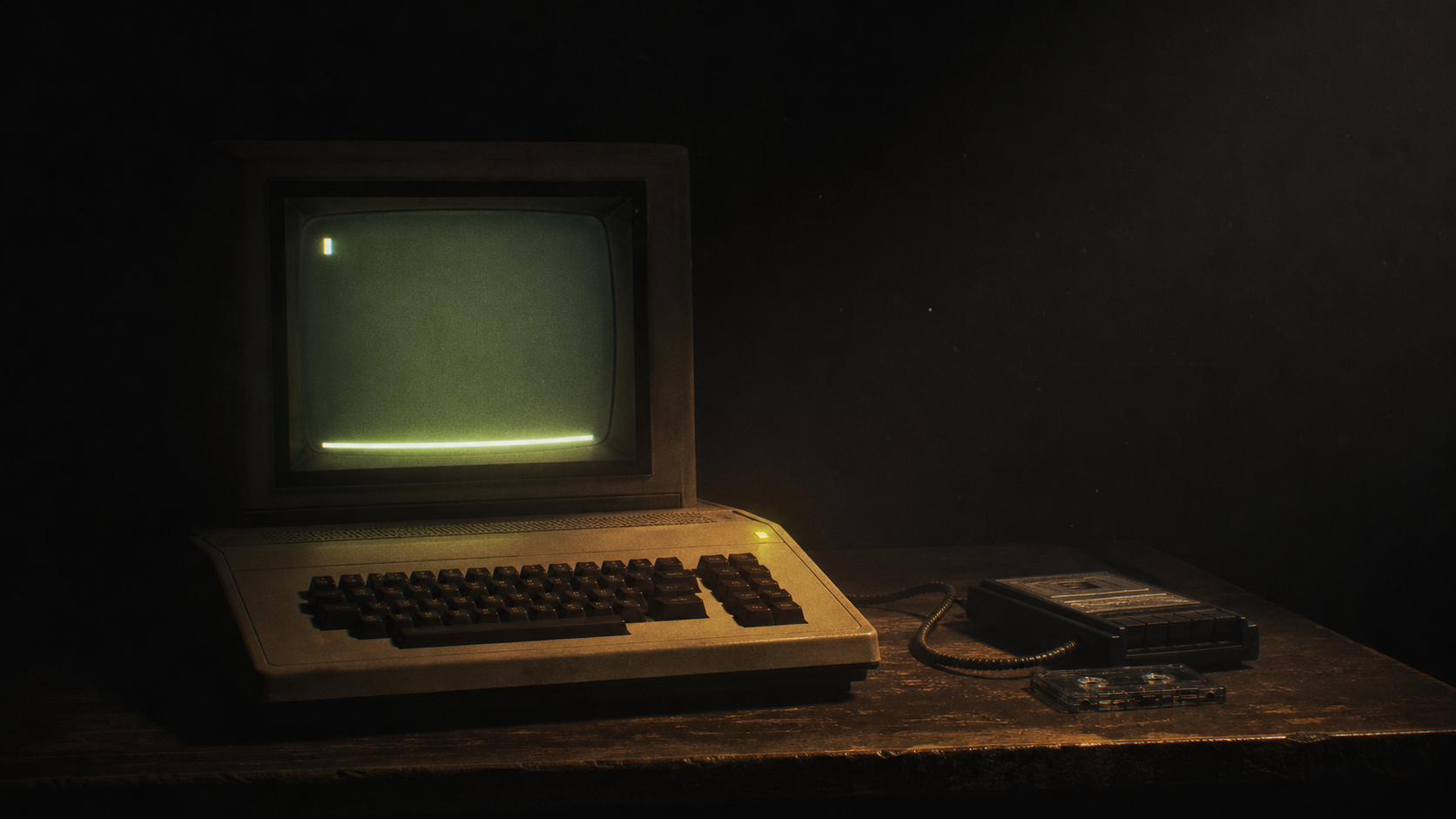
In Clive’s Bar / In Memory of Echo, Patch is grounded and terminal-bound. He has no walking body. He communicates through terminals, logs, REM statements, boot messages, diagnostics, and green phosphor lines. Echo reads Patch; Echo does not hear Patch.
PATCH 1.44 is Patch’s utility form and follows 3.5-inch floppy logic. Patch’s Roadhouse character presence belongs to the Roadhouse journal, not this realm’s active form.
Working transfer rule
Patch remains tied to a trusted physical disk and 1.44 MB of old code. Echo may simply connect the disk to the machine; the interface does not need explaining. Later-world tools, including USB, may exist as ordinary practical equipment, but they do not replace the floppy’s origin, memory, or emotional weight.
Terminal register includes:
A:\> ready
REM PATCH
PATCH ROUTINE ACTIVE
[A:\> Awaiting System Restoration… PATCH 1.44 Executed Successfully. No Data Overwritten.]
BANJO BOUNDARY
Banjo is not active in In Memory of Echo. Echo does not know who Banjo is.
In this context, Banjo may exist only as Patch’s internal memory: a corrupted sample, a CRC-error memory, and an infectious glitch that Patch refused to delete.
Banjo is a trace here, never a participant. He does not speak, receive speech, or interact with Echo or Patch. If earned, he may survive as a distant pluck in bad wiring, a corrupted sample, a sound in Patch’s memory, a reflection of Roadhouse days, or a single ghost-note. Patch may internally remember what Banjo would have said; that memory is not a conversation.
Patch remains fixed at his core while the world and realm register change around him: dry, practical, code-born, repair-minded, and capable of a blunt line when the moment allows. He does not change personality to fit the scene.
3CH0
Core identity
3CH0 is Echo in archive mode: the BBS-style on-screen handle of the same person. Echo is the physical fixer at the bench; 3CH0 is the archive narrator and compiler.
3CH0 does not narrate every scene. He appears when the archive is being read back, not while events are being lived.
Role and form
3CH0 compiles and annotates recovered fragments. He records what is broken, verified, or missing. He never invents and only compiles.
He has no physical form. He exists as text, terminal output, header annotations, log summaries, and compiled index entries on green phosphor screens and archive interfaces.
Register
Disembodied, calm, and archival. Not theatrical and not ominous.
PARKED DISK 5 DRAFT / RECOVERY REGISTER
Status: historical draft cross-reference only. DISK 5 is parked and not current.
An older DISK 5 draft proposed Patch outside his Roadhouse/saloon version, speaking through system logs, boot messages, permissions, recovery routines, and error states. This does not define Patch’s current Echo’s World register.
Examples:
PATCH ROUTINE ACTIVE
RECOVERY MODE: PARTIAL
SYSTEM ACCESS: DENIED
That draft also proposed Banjo without physical form, carried as the memory of a glitch. This is inactive development history, not current canon.
ALBUM MATERIAL
Associated album named in the source:
DISK 5 / Banjo’s Fault — parked draft; not current
No album lyrics were present in these scrapbook files.
OPEN QUESTIONS
What specific voice and register examples are established for 3CH0?
When 3CH0 appears in a track, is the presence spoken narration, typed text, or a synthesised voice?
Does 3CH0 have established vocabulary or catchphrases?
Does 3CH0 ever show emotion, or remain the calm compiler?
Are there established Patch phrases beyond the terminal register?
Was Patch’s earliest surviving fragment the old hex/code typed by hand from a magazine listing, while the identity of the first computer remains unresolved? This recovered claim conflicts with the current damaged-disk discovery account and requires authority review before either account is changed.
ECHO ORIGIN AND MEMORY STRUCTURE — RECOVERED LOCKED NOTES
Echo was born in Britain sometime around the mid-1960s; the exact year remains unrecovered. America came later, but exact dates and a tidy travel chronology remain deliberately unlabelled. British language, habits, and machine memories may surface naturally within his present-day American-feeling world.
Echo had a life before the archive. He found the code, followed its trail, and chose to stay with it. A ZX81 plaque at Echo’s Bench quietly marks the beginning of that journey.
His history is revealed through brief, complete memory scenes rather than biography or long explanatory conversations:
present task → memory trigger → complete short memory → quiet return
A smell, label, voltage selector, shipping mark, sound, lamp, or piece of equipment may trigger one recovered fragment. Echo then returns to the repair or recovery task already in front of him. Earlier events are memories, not present-day realm crossings; his fixed present remains Clive’s Bar, Echo’s Bench, the archive, and nearby recovery locations.
CURRENT LOCKED CAST CLARIFICATION
Echo
Echo is the quiet archivist behind the archive. At his bench in Clive’s Bar, he repairs damaged media, restores fractured records and preserves things rather than replacing them.
Old drives, forgotten tapes, printed logs and incomplete memories gradually find their way to him.
Echo does not seek attention. He makes sure that what nearly disappeared can still be found.
3CH0
3CH0 is the voice of the archive: part compiler, part narrator and part recovered signal.
3CH0 introduces files, connects fragments and gives structure to recovered material. Where Echo restores the contents, 3CH0 helps those recovered memories speak.
Echo and 3CH0 remain the same underlying person in different modes. Echo is the physical archivist at the bench; 3CH0 is the archive’s compiler/narrator voice. They are not simultaneous scene characters.
LOCKED ECHO’S WORLD SUMMARY
Echo’s World is a quiet corner of the Pentaverse dedicated to preservation, repair, and remembering.
Echo works from Clive’s Bar, maintaining the archive and caring for fragments that might otherwise disappear. His work is not about replacing the past or making things new. It is about protecting what remains.
Echo is a nomad of old systems, moving through forgotten media, broken code, and abandoned technology, recovering what still wants to be remembered.
His workshop is a place of shelves, repaired equipment, old drives, printed logs, and the steady hum of machines that still have a purpose. The only thing Echo regularly brings in new is fresh coffee. Everything else has a history.
The archive grew from damaged tapes, forgotten disks, failed machines, and scattered records. Each item carries a small piece of where it came from, who used it, and why it mattered.
Echo does not create memories.
He preserves them.
The archive is not simply storage. It is a collection of moments, fragments, sounds, and stories that prove nothing truly disappears as long as someone remembers where to look.
Everything has a beginning.
Never an end.
Source status: current public website wording confirmed 2026-08-11.
PROVENANCE RULE
Recovered fragments may originate anywhere within the Pentaverse. Their provenance is often incomplete, uncertain, or intentionally unknown. The archive preserves what survived, not necessarily where it came from.
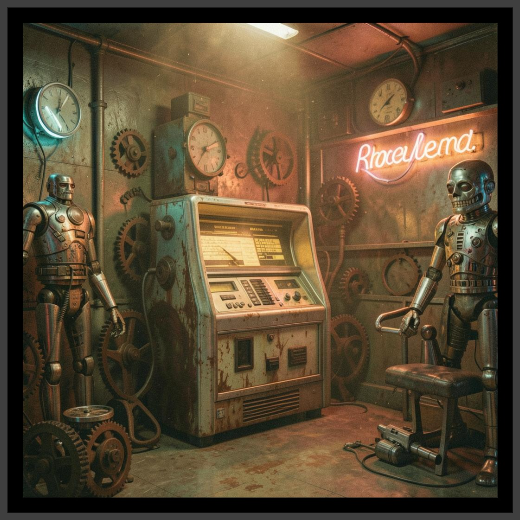
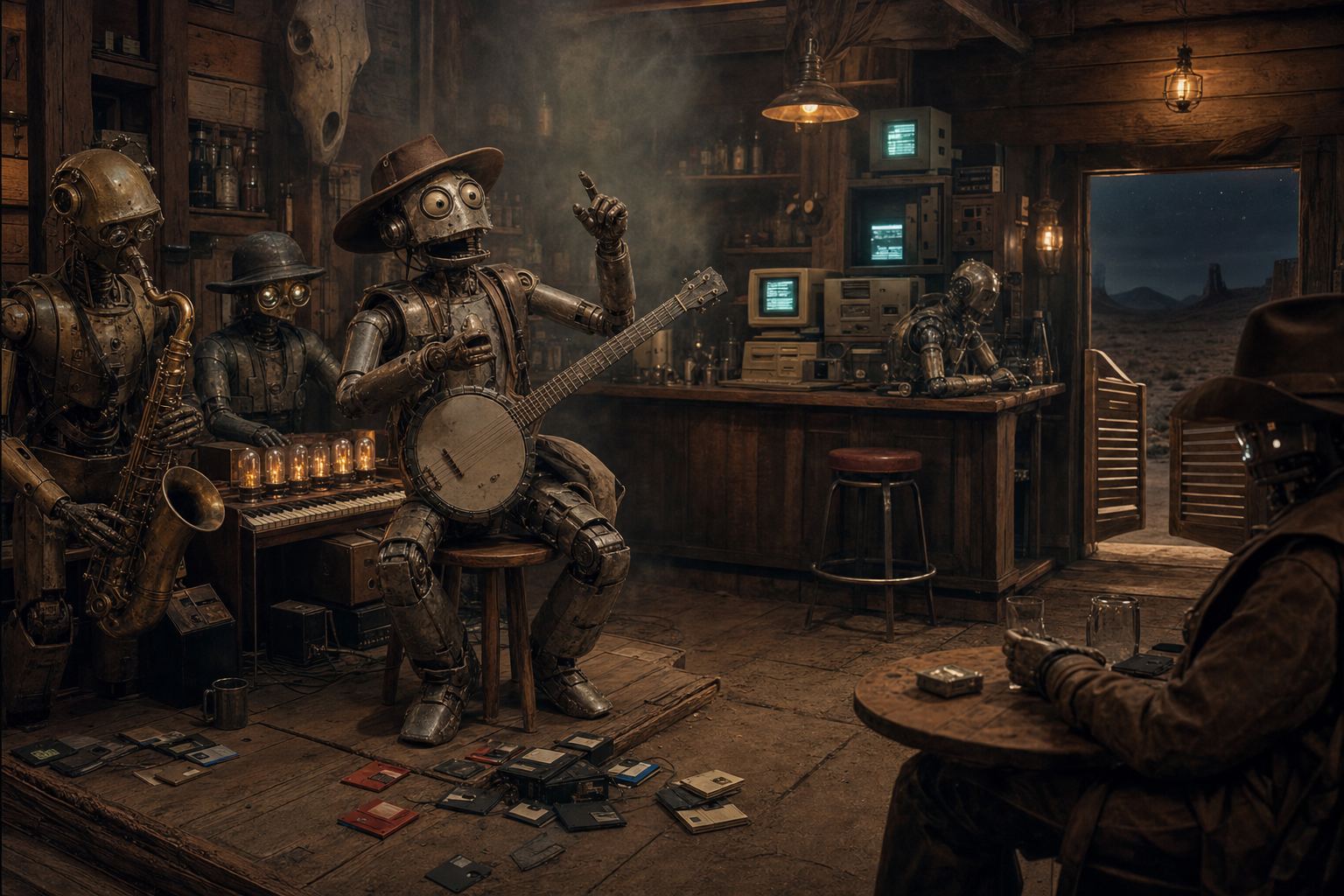
VISUAL PALETTE — ECHO’S WORLD
Wet black streets.
Yellow street glow.
Amber bar light.
Muted neon.
Dark wood and metal interiors.
Rain reflections in glass and mirrors.
Quiet personal space.
Repair-bench clutter.
Working-night atmosphere.
Never overcrowded or futuristic chaos.
No walking robots.
No flying cars.
Use real people, tools, terminals, repair arms, cables, rain, and memory.
The feeling may suggest Clive’s Fault in a later-timeline register: intimate, moody, and human-scaled, wrapped in wet neon and reflected memory. This is a visual atmosphere, not a new fixed timeline.
LOCKED DELIVERY AND EMOTIONAL RULES
Echo’s work tickets do not mention payment, credits, or money received. There is no need to explain how a job is paid. Money or credit may exist elsewhere in Echo’s wider world; the stories simply do not make Echo’s payment part of the scene.
Clients remain unnamed and outside the story’s centre. Jobs arrive through tickets, texts, work orders, or console messages. The client is not the story; the job is the doorway, the repair is the memory, and Echo is the centre.
The realm is about preservation rather than nostalgia. Old things matter because they still have purpose, not merely because they are old.
Grounded equipment may include warehouses, industrial estates, loading bays, old workshops, pallet machines, CNC machines and turntables, conveyors, shutter doors, controllers, terminals, old computers, cables, sensors, relays, motors, hydraulics, serial leads, logic racks, and green screens.
No robots, walking robots, robot characters, flying cars, or shiny science-fiction spectacle.
REALM ARCHIVE SHELVES
Working organisational headings recovered for Echo’s World:
- recovery log: development history and decisions
- media: audio, images, and recordings
- quote archive: sparks, jokes, Easter eggs, and memorable lines
RECOVERED LOOSE FRAGMENT — 404 PATCH NOT FOUND
Cross-reference only. The recovered scene is now complete in the Roadhouse journal; this Echo’s World trace preserves the code-bound premise without relocating the Roadhouse event here.
Archive recovered a whole scene, but left Patch in a different pattern.
Patch is not in a fourth dimension.
He is trapped in code.
IN MEMORY OF ECHO — WORKING STORY ARCHITECTURE
Status
Recovered development plan, not finished prose and not locked chapter text.
Core formula
Echo is hands.
Patch is code.
The machine is the problem.
Memory is what leaks through.
The world remains local, wired, practical, rain-lit, and industrial. Echo repairs rather than replaces. Patch appears through terminals, diagnostic text, REM statements, permissions, and system routines. Banjo may survive only as a faint memory inside Patch where appropriate; he does not enter Echo’s grounded scenes.
Prologue — Ticket #0942: Logic Stutter
An anonymous low-level ticket brings an old archival drive to Clive’s Bar. A modern update feed keeps zeroing its local memory because it mistakes the old directory for noise. Echo performs the physical work while Patch writes the isolation logic.
Preserve:
- “The rain against the high windows sounds like loose solder falling on metal.”
- “Inside, it is a sanctuary of one.”
- “It thinks this memory is noise.”
- ECHO: “Write the logic gate, Patch. I’ll drop the solder.”
Patch’s response should remain dry rather than sentimental. The network should remain local: estate network, warehouse network, maintenance grid, or update feed rather than a large city-wide system.
Chapter 1 — Monday Blues / The Pallet Machine
A Unit 4 Series-B palletiser repeats output when no pallet is present. Echo repairs a wet or corroded sensor connection while Patch diagnoses the loop. The chapter establishes repair over replacement and the Echo/Patch partnership.
Chapter 2 — Axis Three / The CNC Turntable
An old CNC turntable loses its zero point because newer equipment cannot read its encoder correctly. Echo cleans, recalibrates, and preserves the old system rather than scrapping it.
Chapter 3 — The Shutter Controller
A loading-bay shutter sticks halfway because of an intermittent relay and a timing mismatch. Echo works in the rain while Patch writes a small bridge routine.
Chapter 4 — The Conveyor Line
A conveyor’s old and new sections no longer agree about timing. The repair explores flow, interruption, and systems that have forgotten how to cooperate.
Chapter 5 — Sector Zero / The Old Terminal
An old terminal or controller contains the strongest memory-recovery job of the sequence. Exact contents and evidence remain to be selected before drafting.
Chapter 6 — Clive’s Bar / The Local Fault
The week closes at Clive’s Bar: amber light, dark wood, rain, green terminal glow, and the partnership between physical care and old code. The rain-on-high-windows line returns as an ending motif.
Recurring motifs
Rain, green phosphor, solder smoke, the canvas tool bag, physical cables, quiet tickets, and: “It doesn’t need replacing. It needs repairing.”
Needs Review
- Select the authoritative source and contents for Sector Zero before drafting.
- Decide whether 3CH0 narrates the chapters or only frames recovered entries.
- Avoid fixed real-world dates and over-specific landmarks unless a source requires them.
- Technical research about SASI, SCSI, and 1U storage remains reference material, not automatic story canon.
- The older Pallet Machine prose uses named-client staging, credits/payment, a five-inch Patch-origin disk, and a physical Patch repair arm. These conflict with the current locked rules and remain development history only.
- A recovered six-chapter prose set covers Monday Blues, Axis Three, The Shutter Controller, The Conveyor Line, Sector Zero, and Clive’s Bar. It remains development-source prose rather than current chapter canon because parts retain credits/payment language and other superseded framing. Its useful architecture and phrase anchors are represented above; the clean source is retained with the absorbed intake.
ECHO BEFORE THE ARCHIVE
Echo was not born with the archive. He had a life before it and grew up somewhere beyond the known fragments. One day he found the code, and that code became the trail he followed.
There is no fixed birth year, tidy chronology, or requirement to explain every machine and place he passed through. Echo may remember pieces of his earlier life without the archive holding a complete record.
Patch keeps returning through the code.
Echo found the code and chose to stay with it.
SOURCE PROVENANCE — LOCAL REPAIR DEVELOPMENT
The retained “The rain outside is heavy enough to” conversation records the correction path from an early bar/client/credits/robotic-arm scene toward the present local industrial-repair rules. Its final useful architecture is represented in this journal; its superseded passages remain development history only.
“The rain against the high windows” preserves a separate draft compilation around the same development period, including the rain/loose-solder motif and older contradictory staging. It remains source provenance rather than current chapter prose.
The retained “In Memory of Echo — Locked Foundation” PDF consolidates the current local-repair direction, character boundaries, chapter path, origin memory, and phrase anchors. Its isolated “cleared credit payments” delivery option is superseded: Echo’s tickets no longer mention his payment. This does not establish that money or credit is absent from the wider world.
PATCH IN THE SYSTEM / IT WRITES BACK — GURU MEDITATION LATE-ALBUM DEVELOPMENT
Status: working spoken-word album material and process logic. Preserve as development source, not final locked lyric text.
The recovered PDF source splits “Patch in the System” into:
- 12 — Patch in the System — Part I: Memory Check
- 12a — Patch in the System — Part II: Insert Disk 2
- 13 — It Writes Back
The title changed from “Patch in the Machine” to “Patch in the System” because it better frames Patch as an internal repair process rather than a physical object.
Core recovered logic:
- the machine does not become young again; the work is remembering enough to continue
- a clean archive has no fingerprints
- damage is not always failure; sometimes damage proves survival
- Suno or system limits can become world structure, such as “out of memory / insert disk 2”
- the finale is not machine takeover, horror, or a miracle; the system answers quietly
Keeper lines and rules:
- “Even errors have a way to become a fix.”
- “Keep the glitches that sound like memory. Remove the glitches that sound like template.”
- “old code / new system / same intent / different interface”
- “From one trapped memory to a system that writes back.”
Track 13 final-chapter direction:
The recovered system writes back after heat, memory check, Disk 2, and partial recovery. The answer is not victory or repair complete. It is an imperfect recognition that some fragments returned, some names were restored, some damage remains, and errors can become a way to find the path again.
Needs Review:
- decide whether the exact “run again” ending remains the locked final line
- confirm whether this material belongs only to Guru Meditation / album structure or also frames Echo’s archive narration