CORE STATUS
The Roadhouse is one of the Pentaverse’s two inseparable core worlds. It cannot be replaced or displaced by another realm. Its paired core world is Echo’s World, although the two retain their separate boundaries and Echo does not enter the Roadhouse.
STATUS
Current realm journal assembled from scrapbook character recovery notes.
Unresolved items remain marked as open questions.
REALM
The Roadhouse belongs strictly to Patch and Banjo. Echo has never visited it and knows it only through recovered fragments, recordings, logs, files, and damaged media.
Roadhouse exception
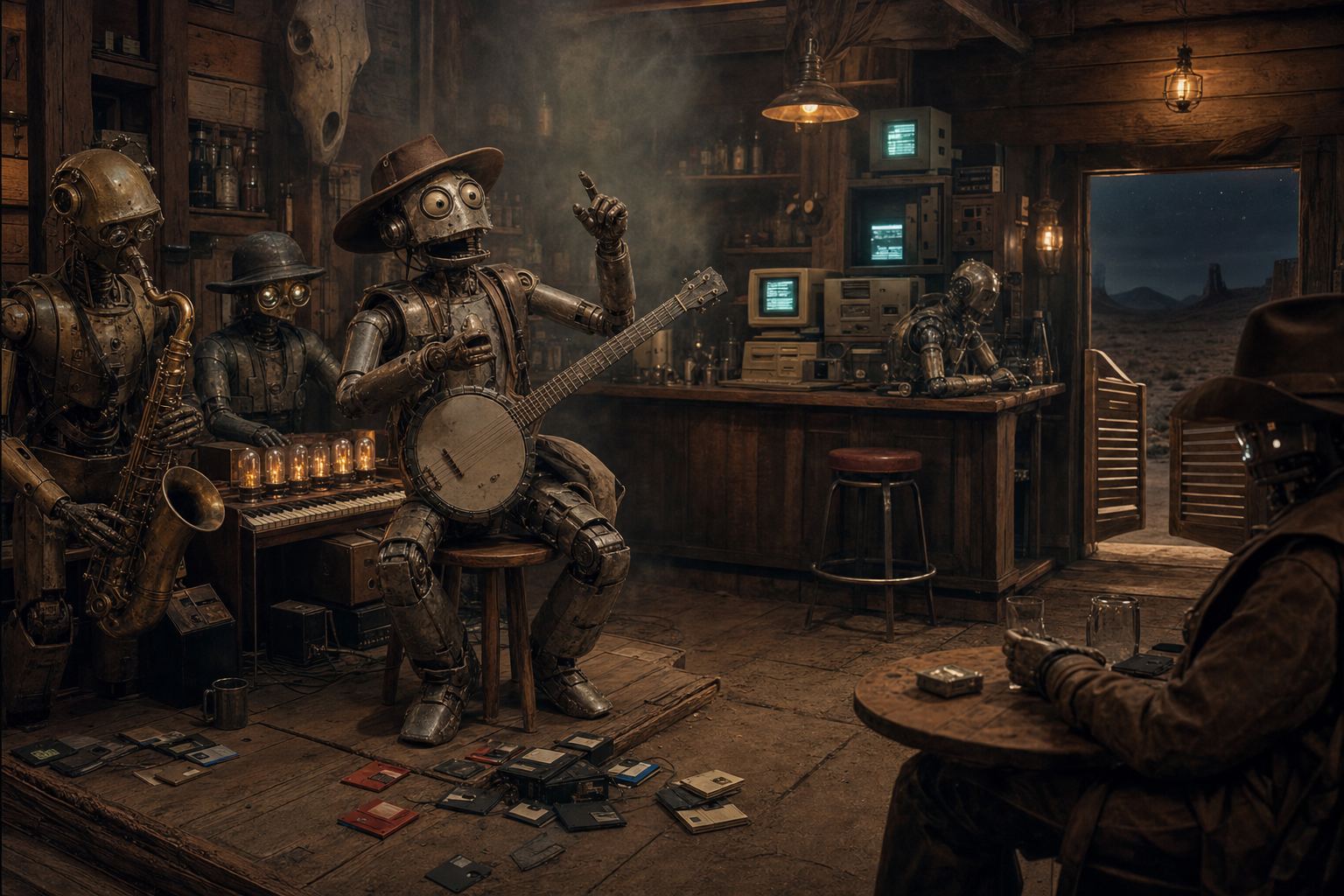
The Roadhouse/saloon is the controlled comic zone where bots, including Patch and Banjo, may gather, perform, malfunction, and interact more openly. This exception does not alter their form, behaviour, or interaction rules elsewhere in the universe.
PATCH
Core identity
Patch is code-born, dry, practical, blunt, funny, repair-minded. He fixes what the rest of the world forgets.
Roadhouse register
In the Roadhouse, Patch has a character presence and can deliver dry, capable one-liners aloud. He is the unofficial sheriff of the Roadhouse.
Patch is unchanged at his core across the Pentaverse, but his form and means of communication follow the rules of the realm. In Clive’s Bar / In Memory of Echo, he is terminal-bound and does not have a walking body. That register belongs in Echo’s world journal.
Physical form
A hulking older-generation machine coated in analogue dirt. A source draft describes a torn synthetic-leather vest with a worn stack of black 5.25-inch floppies in the front pouch as his digital heart, memories, and stash. This imagery is not confirmed as locked current canon.
Voice
Dry, blunt, practical. Capable of one-liners. Never theatrical.
Origin and Banjo
Patch was recovered from old code found by Echo on a damaged disk. Echo fixed enough to make it run and left the comment REM PATCH, which became Patch’s name.
Banjo existed as a corrupted sample with a CRC error. Patch could have deleted him and refused. The fault became friendship.
BANJO
Status
Banjo is locked. He must not be redesigned into a different character.
Core identity
Banjo is the chaotic glitch: a corrupted sample on an old floppy sample disk, rejected because of a CRC error. Nobody wanted the sound. It was thrown away, but the glitch survived.
Banjo is not evil and is not a villain. He is chaos with faulty timing: a comic antagonist and an annoying rather than destructive presence.
Roadhouse register
Banjo is active in the Roadhouse and the Patch n Banjo album. He is a clunky, hyperactive unit with mismatched copper gears, constantly leaning into Patch’s space and treating his banjo as an instrument of pure annoyance.
Voice and sound
Rogue plucks, wrong notes, start-stop rhythm, broken sample chops, and comic timing.
Signature object
The banjo itself, plucked at the wrong moments and used comically as pure annoyance.
Relationship with Patch
Banjo should have been deleted. Patch refused. They have been friends for a long time.
Central statement
“Clive opened the door. Banjo closed it. Patch is still looking for the handle.”
Parked draft callback: an older DISK 5 proposal had Banjo shut the door at the end of Disk 4, causing a door slam, CRT flicker, GURU MEDITATION error, and the line “Disk 5 begins.” DISK 5 is parked and not current; this transition is inactive development history, not a live cameo or crossover.
CROSS-REALM BOUNDARIES
Echo has never visited the Roadhouse.
In In Memory of Echo, Banjo is not active and Echo does not know who Banjo is. Banjo may exist there only as Patch’s internal memory.
PARKED DISK 5 DRAFT CROSS-REFERENCE
An older DISK 5 draft proposed Patch outside his Roadhouse/saloon register and Banjo carried inside Patch as a corrupted sample. DISK 5 is parked and not current. This wording does not define either character’s active canon.
ALBUM MATERIAL
Associated albums named in the source:
Patch n Banjo
DISK 5 / Banjo’s Fault — parked draft; not current
No album lyrics were present in these scrapbook files.
OPEN QUESTIONS
Does Banjo speak in words, or only through music, sample stabs, or broken vocals?
Which Banjo moments or catchphrases from the Patch n Banjo album are established?
Was there a specific incident that developed the relationship from annoying error to the friend Patch refused to delete?
Is Patch’s vest and 5.25-inch floppy imagery still current Roadhouse canon?
Are there established Patch phrases beyond his terminal register?
Are there specific incident-report phrases from the Patch n Banjo album?
RECOVERED INCIDENT: DVR EVIDENCE — SIX FRAMES OF BANJO
Status: working project.
A Roadhouse DVR fault yields six recovered stills. Banjo presents the sequence as proof he was helping everywhere at once. Patch treats it as an incident report.
- The Recorder Needed Attention
Banjo is behind the bar with one finger over a switch labelled DO NOT RESET.
Banjo: “That could be anybody.”
Patch: “You are holding your banjo.” - Unauthorised Technical Inspection
Banjo is half inside the back of the C4 vending machine; only his legs and banjo neck show.
Banjo: “Routine maintenance.”
Patch: “You are not maintenance.”
Banjo: “I was available.” - The Command List Incident
Banjo holds the command list upside down onstage, touching it with a screwdriver.
Patch: “Why were you editing the command list?”
Banjo: “I was proofreading.”
Patch: “With a screwdriver?”
Banjo: “It needed punctuation.” - Restricted Back Room
Banjo leans across the Atari ST with a floppy halfway out of the drive. The door reads:
AUTHORISED PERSONNEL ONLY.
NO MUSICAL INSTRUMENTS.
Banjo: “That image lacks context.”
Patch: “The context is written on the door.”
- Behind the Jukebox
Banjo is wedged behind the jukebox with one arm among the cables.
Banjo: “Improving the signal.”
Patch: “You disconnected the left speaker.”
Banjo: “It was dominating the conversation.” - The Final Frame
Banjo stands before the DVR, finger on its front panel. The timestamp freezes there.
Banjo: “Before you say anything, I can explain.”
Patch: “You caused the fault.”
Banjo: “I prefer ‘ended the surveillance.’”
Patch: “You were incorrectly positioned six consecutive times.”
Banjo: “That still proves consistency.”
VISUAL FORM
A panoramic chronophotography piece may show Banjo repeated in six increasingly suspicious positions across the Roadhouse, while Patch appears once at the far end already holding the incident report.
RECOVERED QUOTE
“The recovery is not about taking control. It is about being recognised again.”
CURRENT LOCKED CAST CLARIFICATION
Patch
Patch’s current cast role is old-code archivist, repair unit and reluctant keeper of order. He protects damaged data, repairs forgotten systems and keeps things running with worn tools, stubborn patience and the suspicion that Banjo has already made the fault worse.
Banjo
Banjo’s current locked physical form is a six-string banjita unit assembled from copper, scrap parts and questionable decisions.
He is musician, entertainer, commentator and frequent cause of unnecessary diagnostics. Every room is a stage, every warning label a suggestion and every technical failure an opportunity for a solo.
Patch and Banjo are rarely in agreement, but almost always appear in the same incident report.
LOCKED ROADHOUSE SUMMARY
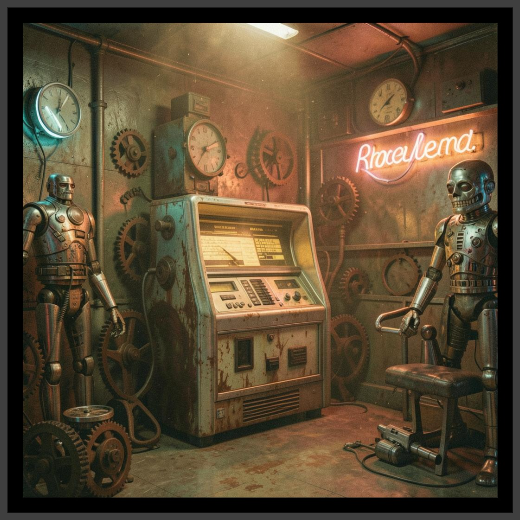
The Roadhouse is where forgotten machines, old music, and recovered memories find a place to be heard again.
Hidden away from the noise of the modern world, it is a place of warm lights, dusty speakers, old instruments, and a jukebox that still carries the songs of machines and memories long after they should have disappeared.
This is the home of Patch and Banjo.
Patch is the old-code archivist who keeps the systems running, protecting fragments of the past and making sure forgotten things are not lost. Banjo is the copper-scrap banjita with a corrupted sense of timing, a broken memory, and a habit of finding his way into places where he was never invited.
The Roadhouse is not a museum. It is not a repair shop. It is a place where things continue.
Old computers, damaged media, forgotten recordings, and strange recovered files all have a story waiting to be heard. Some arrive through the archive, some through the jukebox, and some simply appear after years of silence.
Every song has a beginning.
Every machine has a history.
Every fragment still has something left to say.
The Roadhouse keeps the lights on, the music playing, and the memories alive.
RECOVERED INCIDENT: PARTIAL RECOVERY
Status: working Roadhouse back-room scene.
Fragment sequence: 01–05.25.
01 — THREE TERMINALS
The back room of the Roadhouse was never quiet. Old fans hummed like tired bees, and the air carried the familiar warm-plastic smell of machines left running too long.
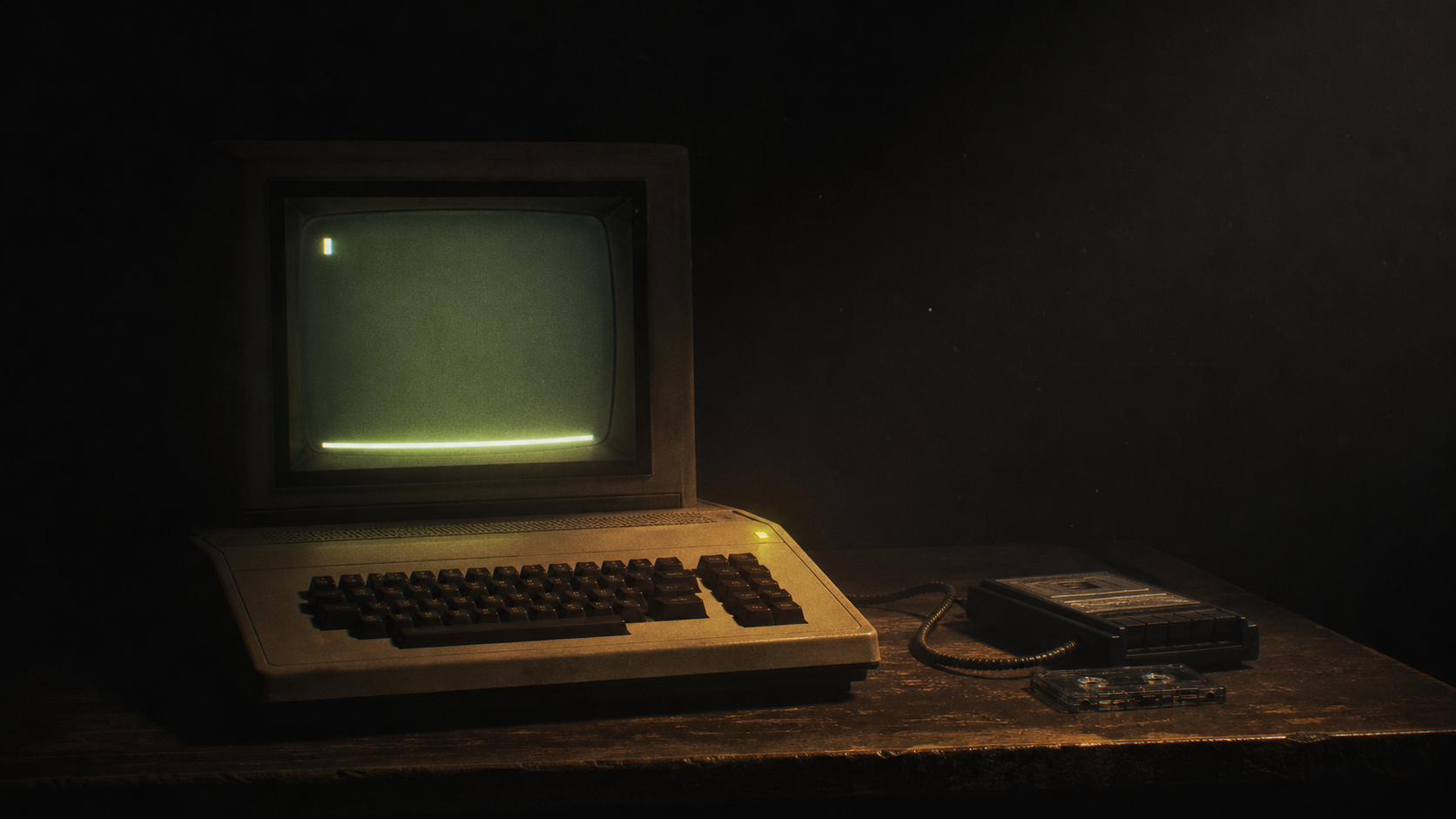
Three green-phosphor terminals sat on the scarred workbench, each wired by thick serial cables into the same battered server underneath, like reluctant siblings sharing one heart.
Patch moved between them slowly and methodically, label printer riding on his hip like an old revolver. He adjusted a loose cable and wiped dust from a bezel.
Banjo had claimed the only swivel chair with two working wheels. He rotated lazily, chewing a dead biro.
PATCH
Three terminals. One system. One operator. Should be straightforward.
Banjo stopped spinning and leaned towards the middle screen.
BANJO
Straightforward? Looks like three different blokes having a barney to me, Patch.
02 — ONE USER
Patch tapped the login banner glowing on every screen.
Same username. Same session identifier. Same faint trail of keystrokes marching across each display like footprints in soft dust.
PATCH
One user. Multiple interfaces. Sessions, cached views, simultaneous changes. Perfectly normal.
BANJO
Then why are they all disagreeing? That one still shows the old folder structure you labelled last month. That one has Echo’s neat revisions. And that one still has yesterday’s unsaved document open like it’s waiting for the operator to come back from his tea break.
Patch’s cooling fan gave a tired whirr. He had explained caching and version conflicts more times than there were bad sectors on a well-loved floppy.
03 — CONFLICTING VERSIONS
The distant operator was clearly in a creative mood. Every few moments, another ripple of change drifted across the terminals like interference on an old VHS tape.
Terminal One clung to Patch’s safe, well-labelled structure.
Terminal Two displayed Echo’s careful revisions with fresh Dymo-style metadata.
Terminal Three held an unsaved document titled:
what_if_we_just_wing_it_v3_final_final_really_this_time.doc
Patch’s error logs fluttered.
BANJO
Three users, mate. One’s the original, one’s the backup, and one’s definitely the suspicious one who keeps moving things when nobody’s looking.
PATCH
Banjo. They’re the same bloke.
BANJO
Exactly. That’s what makes him suspicious.
04 — NOBODY MOVE
A folder icon dragged itself across the middle terminal.
PATCH
Nobody move. I nearly understand the problem.
Banjo froze mid-swivel, one wheel squeaking.
BANJO
Which one of us?
The cursor blinked innocently on all three screens, as if butter would not melt in its buffer.
05 — THE WRONG FOLDER
Banjo decided decisive action was required. Before Patch could stop him, he entered the synchronisation command with two determined fingers.
For one beautiful moment, all three terminals showed the same clean folder structure.
Then all three showed the wrong folder.
Patch watched new versions spawn faster than he could print labels. The chaos was not only Banjo-shaped at this end. The distant operator carried the same cheerfully destructive creative energy.
Two Banjos.
One cable.
Reality quietly weeping in the middle.
Patch stood very still in the green glow.
Somewhere deep in the system, memory after memory forked into new versions of the truth.
05.25 — PARTIAL RECOVERY
The screen flickered.
One terminal went dark. Then another.
Only the middle screen remained, cursor blinking patiently in the back-room gloom.
Patch quietly relabelled what he could.
A single line appeared at the bottom of the surviving terminal, typed by unseen hands:
“All the important bits survived.”
The cursor waited.
Banjo’s voice drifted from the warm dust.
BANJO
See? Told you it counted as a full chapter.
RECOVERED MEMORY FRAGMENT: 404 — PATCH NOT FOUND
Status: DONE. The recovered scene and final ending are complete. Patch is missing from the recovered pattern, not physically absent as a Roadhouse bot and not placed in a fourth dimension.
The terminal blinked twice. Every line vanished.
404 — PATCH NOT FOUND
Please contact the system administrator.
Banjo looked behind the terminal. Then underneath it.
BANJO
Patch?
Nothing.
BANJO
Nobody panic. I have the floor.
VOICE
You were already standing on it.
BANJO
Then the transfer of authority was seamless.
In the studio corner, C4 clicked awake. The vending machine began producing broken recovery tickets:
PATCH RECOVERY — INSERT MEMORY
SELECTION C4 UNAVAILABLE
CREATIVE DEVICE DETECTED
SOURCE NOT REMEMBERED
Banjo read the last ticket as an instruction. He returned from beneath the stage holding an old Sound Blaster 16 card. Most of its lettering had worn away, but one word remained: CREATIVE.
BANJO
Exactly.
He attached it to the jukebox using Patch’s RS-232 cable, two incompatible adapters, and something that may once have belonged to the vending machine.
Three tracks started at once. A fourth began backwards.
BANJO
Six-channel audio.
VOICE
That isn’t six channels.
BANJO
It nearly is.
VOICE
What about 7.1?
BANJO
Nobody can count that high during music.
An oversized Atari 2600 pixel moved from the centre of one screen to its far edge, appeared on the next display, and continued towards the Roadhouse door.
BANJO
Don’t you even think about it.
Banjo pulled the Sound Blaster. Every screen went black. The jukebox continued playing all four tracks. C4 dispensed an empty cup.
The archive had recovered the room, the machines, the sound, and every mistake. Patch alone remained in a different pattern: present somewhere inside the Pentaverse, but unreadable to the recovered system.
Banjo knew Patch should be there. He remembered the absence before he understood it.
Then the tickets stopped. The jukebox clicked. One light returned, then another. The Atari pixel dropped back into place. The vending machine settled into its familiar hum.
The cursor blinked.
The drive ticked.
The room breathed.
10 PRINT “HELLO”
The dusty speaker crackled. Static gathered around a voice that sounded as though it had travelled a very long way through old wiring.
PATCH
Do you remember?
The cursor blinked.
Placement remains Needs Review: whether the completed fragment stays standalone or later becomes part of the Six Frames of Banjo sequence. Completion of the scene does not resolve that filing choice.
WORKING ROADHOUSE ALBUM MATERIAL
Status: development set recovered from a duplicated copier-cleanup conversation. These are working tracks and keeper lines, not automatic locked canon. The source explicitly rejects world-breaking modern props and cartoon escalation.
Album boundary
The Roadhouse album stays object-led and inside the saloon. It keeps Patch and Banjo’s established laws, avoids random modern props, and grounds humour in memory, error, wear, timing, heat, survival, and existing machinery.
TRACK 1 — THE BANJO IS THE COMEDIAN OF THE GROUP
Working opener built around the Roadhouse itself: old wood, neon hum, dust, warm copper, overheated circuit boards, a loose mechanical house band, and one badly timed digital pluck.
Keeper line:
“The banjo is the comedian of the group.”
TRACK 2 — POCKETS FULL OF AMIGA
Working physical-media track centred on Patch’s heavy stash of 3.5-inch Amiga floppy disks and Banjo mocking their clink with a high-pitched twang. The full source contains alternate and split versions; final track length and assembly remain unresolved.
TRACK 3 — THE PIXEL TRIED TO LEAVE
Working scene/track built around an oversized old-game pixel moving between screens and towards the Roadhouse door. Banjo notices the attempted escape and intervenes. This overlaps imagery later used in “404 — Patch Not Found”; final placement remains unresolved.
TRACK 5 — LOGIC SESSION IN A DESERT SHACK
Working track set in a dusty back partition of the Roadhouse where an unrendered Logic project, cheap speakers, heat, voltage dips, buffer glitches, fan noise, and an imperfect slide-guitar take strain against a clean grid.
Keeper lines:
“We come here to hear the system sweat.”
“Some errors are seasoning. Others are project management.”
“If the mistake makes the pulse more honest, leave it where it fell.”
“Some sessions only tell the truth before the bounce.”
“No bounce file found. Session recovered.”
PROPOSED CLOSER — ARCHIVE THE NIGHT
The closer happens at dawn after the Roadhouse sessions. Patch uses a physical 3.5-inch disk and the console’s latch rather than a phone or cloud prop. The room offers an automatic remote backup even though Banjo has not touched the keyboard.
Banjo reversal rule:
The only thing worse than Banjo touching the keyboard is Banjo not touching the keyboard.
Keeper lines:
“It’s time to archive the night.”
“The cloud has no latch.”
“Load it again, little machine. The night is archived.”
Needs Review:
- final Roadhouse album title and full running order
- whether the source’s Track 3 remains separate from the 404 fragment
- where the missing Track 4 sits, if it exists
- whether the proposed closer becomes Track 11
- final lyric edits after consecutive duplicate lines are removed
AUDIO STATUS — TWENTY FIVE PINS
Status: LOCKED — current Roadhouse instrumental theme.
Source link: https://suno.com/s/qtBTI4WylbfJ1J35
The track was a happy accident: lyrics were pasted into Suno’s simple “describe your song” field and the result was a complete instrumental with no C4-style failure and no editing required.
Source generation:
Generated unintentionally from the RS-232 lyric pasted into Simple Mode. The resulting instrumental established the core Roadhouse sound and later became the sonic reference for future tracks.
“Twenty Five Pins ” is the current locked instrumental theme for the Roadhouse. The title retains the <less_gnd> suffix.
WORKING LYRIC — THE DENTED FIDDLE LOOP
Status: recovered working Roadhouse lyric. Not locked canon or a finished production master.
Title: The Dented Fiddle Loop
Style: lo-fi tracker country, bitcrushed fiddle loop, repetitive mechanical groove, jaw-harp twang, snappy boot stomp, 120 BPM, quirky cyber-western barn dance, glitched retro computing, hypnotic electronic folk, deadpan baritone vocal.
Full lyric preserved in pentaverse_master_lyric.md under # The Dented Fiddle Loop.
Needs Review:
- “Banjo bot” and “dented bots with iron feet” may fit the Roadhouse register, but the exact physical staging is not automatically locked.
- “Nobody fixes anything” may conflict with Patch’s repair-minded role; retain as lyric wording pending production review.
- “Kick the power strip” needs review against the non-destructive tone.
Source provenance: Gpt suno The Dented Fiddle Loop.md, intake date 2026-08-11.
RECOVERED ROBOT ROADHOUSE SESSIONS — ALBUM 2 DRAFT SET
Status: working lyric and production drafts recovered from 22.md. These titles, track numbers, lyrics, props, and world details are not automatically locked canon. The full source is retained in absorbed intake for lyric-level recovery.
Track 2 — Pockets Full of Amiga (The Floppy Disk Rattle)
Patch carries 3.5-inch double-density Amiga disks whose shutters and shells become the percussion layer. Banjo mimics the rattle. The draft’s core image—physical archive weight carried like spurs—supports the existing working track, but claims about exact contents and capacity remain draft detail.
Track 3 — Trail Footage
A relaxed 90 BPM campfire-country-jazz draft about recording dirt trails and evening light with imperfect old equipment. It connects creative pottering, riding, low-resolution footage, and remembering the journey. Needs Review: the drone, service bot on a bike, personal-life references, and movement outside the Roadhouse may place this outside the current realm boundary.
Track 5 — Logic Sessions in the Sand
An earlier, more expansive counterpart to Logic Session in a Desert Shack: Logic Pro on a MacBook and whiskey crate, solar power, sandstorm, latency, clipped audio, and a session saved despite unstable conditions. Keep as development history; the current tighter Roadhouse version avoids unnecessary world expansion and modern-prop emphasis.
Track 8 — Midnight at FidoNet
Dark ambient country at 76 BPM, using slide guitar, space pads, jaw-harp beacon, Zone Mail Hour, packet routing, and late-night node-to-node exchange. Needs Review: internal radio antennas, satellite imagery, and the line to London conflict with or stretch the Roadhouse’s established local, object-led boundaries.
Track 9 — Sound Blaster Serenade
Nostalgic 100 BPM synth-blues celebrating the arrival of PC sound cards, FM synthesis, stereo audio, Creative Labs hardware, DMA and interrupt settings. Its strongest archive value is the transition from primitive speaker beeps to a machine that could “sing.” Exact technical claims and the 5.1-card joke require review.
Track 10 — No Glossy Polish
Stripped-back 92 BPM campfire blues expressing creative pottering with intent: no chart chasing, corporate committee, perfect grid, or sterile polish. Keep the philosophy and dry acoustic production direction. Needs Review: direct autobiography, explicit Suno reference, money wording, and “AI robots singing pop tracks” do not belong automatically in Roadhouse canon.
Track 11 — The Last Diskette Latch
An earlier proposed cinematic dawn closer related to Archive the Night. Patch saves the Roadhouse session to a physical 3.5-inch Amiga disk, flips the write-protect tab, writes the directory, places the disk in a wooden box, and ends on the drive latch ejecting. The physical save ritual is strong; the stadium-scale climax, twelve-track claim, humanoid band staging, coat details, and exact “track seventy-nine” line remain draft choices.
The Dented Fiddle Loop is already preserved above as its own working lyric and is not duplicated again here.
ADDITIONAL ROADHOUSE LYRIC DRAFTS — INTAKE 11
Status: recovered working material. These summaries preserve the useful track identities while the complete drafts remain in absorbed intake. Destructive, exaggerated, or realm-stretching details are not promoted to canon.
Banjo Has Been Asked To Stop Touching The Command List
A high-tempo boom-bap incident built around Patch urgently guarding a command list while Banjo insists he is helping. The recurring alarm, mechanical keyboard, permission warning, and Patch/Banjo call-and-response suit the existing Command List Incident. Needs Review: the melting server room, torn cables, burst drive, weapons-like props, “walking catastrophe,” murdered-machine wording, power failure, and deleted boot-sector/floor ending overstate Banjo and conflict with the non-destructive Roadhouse tone.
Joystick Wear
A full working lyric about an old joystick whose worn grip, loose spring, microswitch clicks, hand marks, and imperfect movement preserve evidence of years of play. Its strongest idea is that physical wear is memory rather than damage to be polished away. Needs Review: embodied robot movement and any staging outside the Roadhouse.
Broken Fiddle Loop
A full extended tracker-country draft related to, but distinct from, The Dented Fiddle Loop. A damaged fiddle sample, CRC rhythm, buffer choke, jaw harp, boot stomp, and repeated loop turn a fault into communal music. Needs Review: dancing bots, physical feet, destructive handling, and any suggestion that Patch welcomes preventable damage.
Midnight at FidoNet — full-draft provenance
The recovered source contains a complete lyric behind the existing Album 2 summary: Zone Mail Hour, packet routing, modem-rack sound, late-night nodes, slide guitar, space pads, and jaw-harp beacon. Existing concerns about antennas, satellites, London, and realm boundaries remain unresolved.
Roadhouse machine-selection scheme
A formal-design source proposes even C4 selections for Speedball, Guru Meditation, and Sound Blaster, with Clive’s Fault on odd selection C5 as a deliberate exception. This is useful interface development only; it does not replace the current C4 wrong-selection gag or establish a locked jukebox map.
Source provenance: 01.md, stuff.md, lost.md, and lok_l_roadhouse_markdown_source.md, intake date 2026-08-11.
PARTIAL RECOVERY / THREE TERMINALS — SOURCE VERSION
Status: source variant for the existing Roadhouse back-room studio incident.
The recovered source preserves the plain prose version of “Partial Recovery” with three green-phosphor terminals wired into one battered server, one remote operator, conflicting folders, and Banjo synchronising the terminals into the wrong folder. Its central idea is unchanged: one user, multiple interfaces, version confusion, and creative chaos mirrored between the operator and Banjo.
Keeper lines:
- “Three terminals. One system. One operator. Should be simple.”
- “Banjo, they’re the same bloke.”
- “Nobody move. I nearly understand the problem.”
- “For one beautiful moment all three terminals showed the same folder. Then they all showed the wrong folder.”
- “All the important bits survived.”
Provenance: Roadhouse Back-Room Studio – Recovered Incident Log.md, intake date 2026-08-11.
RECOVERED ARCHIVE ENTRY 01457 — ROADHOUSE AUDIO-MEMORY FRAGMENT
Status: atmospheric recovered-entry source; not locked literal canon.
The fragment frames a volatile audio-memory recovery from the Saloon server rack, with partial tape/floppy mirroring, sector rot, emotional bleed, failed mount attempts, and a buried file tree under corrupted system logs and failed coffee orders.
Useful archive language:
- “They called it a reset. We called it Tuesday.”
- “DO NOT FORMAT (probably)”
- “DO_NOT_OPEN_BANJO”
- “phantom nostalgia, unexpected modem tones, or sudden urges to check old floppy disks”
Needs Review:
- the “original robot saloon configuration” and “forced factory reboot” wording should remain atmospheric until supported by stronger Roadhouse canon
- the “Model 7 administrative unit” label for Patch is source flavour, not a current locked character classification
Provenance: Recovered Pentaverse Archive Entry -01457-.md, intake date 2026-08-11.
ADDITIONAL ROADHOUSE / SALOON LYRIC DRAFTS — INTAKE 12
Status: working lyric and production drafts. These preserve song identities and useful production direction; exaggerated destructive details, robot-body staging, and realm-stretching claims remain under review.
Clive’s Fault / The Saloon
Multiple drafts place the Clive spark, ZX81/rubber-key origin, tape loading, BASIC, Amiga trackers, Guru Meditation, and “Hello Patch… Help us remember” into deadpan spoken-sung saloon/blues production. The strongest line remains the public-canon direction: Clive’s Fault is the joke; the spark is the tribute.
Elite / wireframe space memory
A Track 4 draft uses black-and-white wireframe space, joystick pressure, scanner beeps, and sparse desert blues to preserve early-game imagination. Needs Review: overt space-Western language and named game references should remain memory/history texture unless a project requires them.
Floppy Disk Held Like A Weapon
The theatrical floppy-threat scene belongs with incident-report staging and the existing confirmed exception that a floppy can be presented like a comic “weapon” inside that track title. It never permits real physical damage or changes Patch’s non-destructive core.
Pentium Heat
A late-hardware draft uses beige towers, whirring cooling fans, Sound Blaster, Nvidia, CRTs, LAN-party heat, distorted slide guitar, chunky drums, and industrial country breakbeat. Needs Review: “saloon catches fire”, sparks, and melting hardware are production exaggerations only.
Patch in the Machine / Patch in the System
The older “Patch in the Machine” lyric draft treated present-day human-machine collaboration as a warm finale. The later PDF source supersedes the title toward “Patch in the System”; retain the partnership tone but prefer the newer title where album continuity matters.
Banjo / system-disaster incident drafts
The source includes “Banjo Has Been Asked To Stop Touching The Command List”, “I Formatted My Boot Drive”, “Root Access For A Banjo”, “No USB Recovery”, “The Printer Has Joined The Network”, “Blue Screen At The Robot Saloon”, “Wrong Driver, Right Disaster”, and “The Backup Was On The Broken Disk.” These are useful incident-report development pieces about terminals, failed recovery, printers, drivers, blue screens, lost backups, and Patch/Banjo friction. They remain draft material because many details overstate deletion, murder language, destroyed ports, physical robots, or catastrophic shutdown.
The Delayed Arm / Unquantised Heartbeat
The delayed-drummer concept preserves a strong production philosophy: imperfection can create groove. Needs Review: robot drummer embodiment is a performance image, not automatic realm canon.
Microswitch Callouses
The lyric preserves physical wear, joystick effort, mechanical buttons, and manual friction as memory. Needs Review: direct battle/destruction language and any bot staging outside the Roadhouse boundary.
Provenance: suno_master_lyrics.md and Yes, mate.pdf, intake date 2026-08-11.